
Different industry and trade bodies have extended their support to BangaloreIT.in, the premier annual IT event organised by the Karnataka government and STPI. The three-day event will be inaugurated on the 29th of October in the premises of Bangalore International Exhibition Centre (BIEC).

"On space, we will be able to announce that India is signing the Artemis Accords, which advance a common vision for space exploration for the benefit of all humankind," a senior administration official said hours before the meeting between Prime Minister Narendra Modi and President Joe Biden in the Oval Office.

Indian plants -- who plan to begin production with 28 nano metre chips -- will take two to four years to get off the ground. By that time, in the fast changing world of chip making, the global market would have shifted to 22 nm.

Rather, cold reactions are expected considering the contentious issues the US is bound to raise -- Taiwan, human rights, and North Korea.
'The quality of a leader should be such that even if the leader is not there, the institution carries on.'

Allowing 12-hour shifts for all and night-time work for women was meant to benefit software firms, but is said to have clinched Foxconn's Rs 80 billion investment.
The Tamil Nadu government is proposing a nanotechnology park, similar to the highly successful Hsinchu Science Park in Taiwan. The park, likely to come up near Chennai, will focus on hi-tech manufacturing in semiconductor foundries, chip assembly and testing, optoelectronics, solar cell technologies and nanotechnology.

India and the US on Friday said they have started talks to put in place a strategic framework for human space flight by year-end as they plan to send an Indian astronaut to the International Space Station in 2024.

'Investing abroad helps mitigate currency risk for foreign-currency denominated goals, such as children's higher education and international travel.'
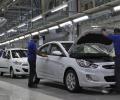
Domestic passenger vehicle retail sales declined eight per cent in February as the companies continued to suffer production loss due to chip shortage, automobile dealers' body FADA said on Friday. The passenger vehicle (PV) sales dropped to 2,38,096 units last month, down 7.84 per cent from 2,58,337 units in February 2021. "Even though the passenger vehicle (PV) segment saw some launches and slight respite in supply due to better production, it was not enough to meet customer demand. "Vehicle waiting period thus remains similar to what it was in the past few months," FADA president Vinkesh Gulati stated.
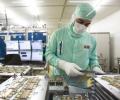
Mumbai-based Indian Semiconductor Manufacturing Company (ISMC) and Singapore-headquartered IGSS Ventures have one strategy in common: They have told the government in their application for semiconductor fabrication plants that they will export the bulk of the chips they make in India in the initial five or 10 years. The third applicant, Vedanta-Foxconn, which is also building a fab plant, has said it will concentrate on the needs of consumer electronics and mobile device markets, and earmark 80 per cent of output for domestic consumption, but has not specified its customers. Finding a viable domestic market could well be the biggest challenge for India's renewed tryst with semiconductors. Fab plants do not sell directly to end users but to intermediary chip design companies - such as Qualcomm or MediaTek.

The global semiconductor shortage hit passenger vehicle sales in September, with major manufacturers like Maruti Suzuki, Hyundai and Mahindra & Mahindra reporting a decline in sales on Friday. Kia India and Honda Cars also reported a dip in wholesales last month as compared with the year-ago period. Carmakers like Tata Motors, Toyota Kirloskar Motor, Nissan and Skoda, however, reported an increase in passenger vehicle dispatches last month despite supply chain issues.

A disagreement between mobile operators and device manufacturers over e-SIMs has reached the government with the Cellular Operators Association of India (COAI) asking the DoT to order handset manufacturers to introduce eSIMs, in addition to the physical SIM slot, in all smartphones costing over Rs 10,000. The reason is the unprecedented global shortage of semiconductors which has severely impacted the supply of SIM cards across the globe and pushed up the price by four to five times. The shortage is not likely to improve before 2024.
Foundries in Taiwan account for more than 75 per cent of the chips that mobile devices made in India need, according to estimates by the Indian Cellular and Electronics Association (ICEA), which represents global and domestic manufacturers. The number is slightly lower, 60 per cent, if one considers all chips -- those of consumer electronics, PCs, laptops, autos, etc. This ties in with the fact that foundries in Taiwan, led by TSMC, account for over 70 per cent of the world's microchip supply, according to estimates by Gartner.

Automobile dealers' body FADA on Tuesday expressed concern that the chip shortage issue could derail passenger vehicle (PV) retail sales during the festive season, as automakers are struggling with an adequate supply of vehicles to dealers due to production challenges. Terming semiconductor shortage as a "full-blown crisis", the industry body warned of a lacklustre festive season, especially for the passenger vehicle dealer fraternity, with low inventory levels and non-availability of the fast-moving model variants ahead of the peak festive period.

While chips have become ubiquitous, Moore's Law has remained a self-fulfilling prophecy even half a century later. Not bad for an industry where the time scale is not measured in decades and centuries, but in annual quarters, says Shivanand Kanavi.
Shortage of semiconductors, price hikes pull January auto sales into red. Dec had seen sales grow for 1st time this FY, which dealers called a one-off.

Despite the robust growth in this country, Apple's India share in its overall global sales remained modest -- constituting 1.5 per cent of its overall turnover of $389 billion in FY23.

India can become the number one automotive manufacturing hub in the world within five years, but auto companies need to enhance safety features to reduce deaths due to road accidents, Union Minister Nitin Gadkari said on Thursday. In his inaugural address at the Auto Expo 2023 here, the minister for road transport and highways asserted that the government's target is to reduce these accidents by 50 per cent before the end of 2024 while asking the auto industry to take suo moto action for road safety as the government doesn't want to make anything mandatory. Gadkari's sentiments were also echoed by Minister of Heavy Industries Mahendra Nath Pandey, who lamented that while India has only 1 per cent of the total overall vehicles, the country accounts for 11 per cent of the total global deaths due to road accidents.

Dealers across brands are slashing prices by Rs 20,000 to over Rs 1 lakh, depending on the car model.

'The fact still remains that we will have to deliver, so the pressure is now on us to make sure we get our resources, our supplies lined up at acceptable costs.'

Mutual fund (MF) houses have started realigning their overseas product offerings after the Securities and Exchange Board of India (Sebi) advised them to stop subscriptions. PPFAS Asset Management has decided to suspend transactions in Parag Parikh Flexi Cap Fund with effect from February 2, 2022. Though new lump-sum and systematic investment plans (SIPs) will not be accepted, existing SIPs and systematic transfer plans (STPs) will continue.
Leading microchip providers Qualcomm and Intel say the chip shortage might last anything between four months to a year, perhaps even two years, depending on the various product categories - mobile devices, ICE, electric vehicles, appliances, data centres. Prakash Mallya, MD, Intel India and vice president, sales and marketing and communications group, said the spike in demand was huge, and cut across segments from PCs, phones, appliances and auto leading to the shortage.

Automobile retail sales in India clocked best-ever performance last month aided by robust registrations across segments including passenger vehicles, two-wheelers and commercial vehicles, automobile dealer' body FADA said on Friday. The overall automobile retail sales rose by 26 per cent to 23,80,465 units last month, as compared with 18,93,647 units in November 2021. "November 2022 has clocked highest retails in the history of Indian automobile Industry with March'20 as an exception when retails were higher due to BS IV to BS VI transition," Federation of Automobile Dealers Associations (FADA) president Manish Raj Singhania said in a statement.

With Onam and Raksha Bandhan just around the corner, the festival season is ready to kick off in full swing. As people embrace the celebratory spirit, companies anticipate a surge in sales this year. Consumer durables firms are expecting strong growth of 40-50 per cent in the premium segment during the upcoming season. Appliance makers also foresee increased demand for cooling appliances - refrigerators and air conditioners - which were impacted by unseasonal rainfall.

The July-September quarter results of software companies in the engineering research and development (ER&D) segment were broadly in line with expectations, though there have been cuts in revenue growth guidance. While results were a mixed bag, and there are cautionary views on the near-term outlook, brokerages and global consulting firms highlight the strong growth trajectory for the sector. They expect this segment of the software sector to grow by 8-12 per cent going forward.
Leading carmakers Maruti Suzuki, Hyundai and Tata Motors reported robust dispatches to dealers in May on the back of strong demand for passenger vehicles across regions, even as the global semiconductor shortage continued to impact production. Mahindra & Mahindra, Kia India, Toyota Kirloskar Motor, Honda Cars and Skoda also witnessed strong demand for their models last month. The month of May also witnessed Tata Motors race ahead of Hyundai in terms of domestic wholesales.

Billionaire Mukesh Ambani's Reliance Jio on Friday announced deferring the roll-out of the JioPhone Next - the low-priced smartphone it has developed with Google - to Diwali. The phone was previously to be launched on September 10. Ambani at the shareholder meeting of his flagship Reliance Industries in June, had stated that the JioPhone Next will be available for purchase on September 10.

The industry is expecting double-digit growth on a year-on-year basis, helped by a possible price correction after softening of raw material inputs and factors such as positive sentiments, pent up demand and improving economic conditions. Besides, a shift in consumer behaviour from price consciousness towards technologically advanced premium products with quality, value proposition and safety aspects leading to a rise in demand for home automation products is making the industry upbeat. With the government's production linked incentive (PLI) scheme for white goods, which has witnessed a committed investment of Rs 4,614 crore, in place, many manufacturers are gearing up to make the most out of the opportunity as well as take steps towards reducing their dependency on imports and make products more affordable.

Passenger vehicle (PV) retail sales rose to 184,134 units last month against 85,733 units in May this year as the COVID-19 situation improved across the country. According to the Federation of Automobile Dealers Associations (FADA), which collected vehicle registration data from 1,295 out of the 1,498 regional transport offices (RTOs), two-wheeler sales rose to 930,324 units last month as compared to 410,757 units in May.

The proposed India-Israel trade pact should be beneficial to both nations and until New Delhi gets a good deal, it would not do an agreement, Commerce and Industry Minister Piyush Goyal said. India and Israel are negotiating a free trade agreement (FTA) since May 2010. "With Israel, until we get a good deal, we will not do an FTA. It has to be reciprocally beneficial," the minister said in San Francisco on Tuesday while interacting with the Indian community.

Clock 11% growth in the first 11 months of 2022.

Automobile retail sales in India increased by 37 per cent in April on a low base of COVID-hit April last year, automobile dealers' body FADA said on Thursday. Total sales across categories rose to 16,27,975 units in April, as compared to 11,87,771 units in the year-ago period. On a year-on-year basis, all vehicle categories including passenger vehicles and two-wheelers were up as compared with April last year.

The first leg of the 35-day festive period, which ended with Dussehra, failed to bring any cheer for auto companies. While makers of passenger vehicles struggled to meet demand due to the persistent shortage of semiconductors, a recovery in demand remained elusive for two-wheeler manufacturers despite offers and schemes. The overall season, which ends two days after Diwali, is unlikely to bring any turnaround in either the supply or the demand scenario, said dealers and officials at auto companies.

Automobile dealers' body FADA on Thursday said passenger vehicle (PV) retail sales in March witnessed a year-on-year growth of 28.39 per cent to 279,745 units, as compared to the year-ago period which saw disruptions in the market due to COVID-19 led lockdown. According to the Federation of Automobile Dealers Associations (FADA), which collected vehicle registration data from 1,277 out of the 1,482 regional transport offices (RTOs), PV sales stood at 217,879 units in March 2020. Two-wheeler sales, however, declined 35.26 per cent to 11,95,445 units last month, as compared to 18,46,613 units in March 2020. Commercial vehicle sales also declined 42.2 per cent to 67,372 units, as against 116,559 units a year ago.

The lockdown in Maharashtra will have a catastrophic impact on April sales, as dealers will not be able to realise the potential of festivities like Ugadi, Gudi Padwa, Baisakhi and Poila Boishakh.
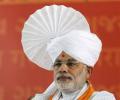
This will be the first time BJP's prime ministerial candidate holds a discussion with IT, telecom czars.

The Eknath Shinde-led Maharashtra government has come under fire following the Centre's announcement that Tata-Airbus C-295 transport aircraft project would be set up in Gujarat, with the opposition seeking to know why the project that was supposed to come up in Maharashtra went to the neighbouring state.

Andhra Pradesh Chief Minister N Chandrababu Naidu, who was instrumental in developing Hyderabad as a key information technology services destination in the country, is now embarking upon a mission to establish the state as an electronics manufacturing hub.
